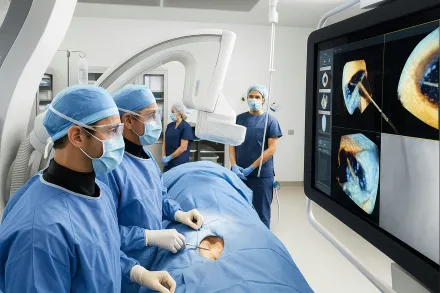
Augmented reality AR sits at the intersection of digital information and the physical environment, blending live surgical views with layered data to guide decisions, measure alignment, and refine motion. In the operating room this technology acts as a dynamic navigator, projecting patient-specific anatomy, instrument tracking, and real-time analytics into the surgeon's field of perception. The promise of AR is not merely to overlay static diagrams but to create an integrated, contextual canvas that synchronizes radiologic images, preoperative plans, and intraoperative findings with tactile feedback from instrument tips and tissue responses. In this way AR becomes more than a display mechanism; it acts as a conversational partner with the surgical team, translating complex data into actionable cues that can be assimilated without breaking focus on the patient. The evolution of AR in surgery has been gradual, moving from laboratory demonstrations to clinical deployments that emphasize safety, reliability, and reproducibility. The trajectory reflects a broader transformation toward data-enabled precision where visualization and guidance are treated as core elements of the operative workflow, shaping how teams prepare, communicate, and respond to unexpected events within the theater of care.
Historical context and technological foundations
To understand the current impact of augmented reality in surgery it is helpful to trace its roots to the broader family of computer-assisted visualization and navigation that emerged with image guided procedures. Early efforts relied on simple overlays and two dimensional screens that required the surgeon to translate flat information into a three dimensional understanding of anatomy. As tracking technologies improved and imaging modalities matured, researchers began to combine three dimensional reconstructions with real time data streams, creating the first prototypes of AR systems that could register patient anatomy to the physical world. The critical turning points involved advances in image registration accuracy reliable tracking of instruments and patient reference frames, and the development of displays capable of producing stable, legible overlays without obstructing the surgeon’s view. Pioneering studies demonstrated that surgeons who could see virtual guides aligned with focal anatomy experienced improved precision in tasks such as implant placement and tumor resections, even when working in constrained spaces or with limited direct access. These early explorations established the belief that augmented reality could reduce cognitive load by consolidating disparate sources of information into a coherent visual narrative that respected the tempo of the operation and the feedback from tissues, instruments, and anesthetic conditions.
Over time the technology matured toward systems that integrated high fidelity three dimensional models derived from preoperative imaging with real time intraoperative data such as ultrasound, fluoroscopy, or optical tracking. The resulting platforms offered a malleable layer that could be scaled from a single display to a fully immersive headset, and they began to be tested across specialties from neurosurgery to orthopedics. The convergence of computational power, advanced optics, and improved sterilizable hardware created a practical pathway for AR to enter the operating room with an acceptable risk profile and meaningful utility. At the same time clinicians demanded that these tools be compatible with existing workflows, be easy to use under the pressures of a live procedure, and deliver consistent results across patient anatomies, surgeon preferences, and operating room configurations. This insistence on reliability and integration set the stage for more widespread adoption and ongoing refinement grounded in real world experience rather than theoretical promise.
Core technology that enables AR in the operating room
The practical functionality of augmented reality in surgery rests on a sequence of interdependent components that transform raw data into usable guidance. At the core is a robust registration process that aligns virtual content with the patient’s actual anatomy in space. This alignment must be preserved as the patient or instruments move and as tissues deform, requiring sophisticated tracking algorithms that fuse data from optical markers, surface scanners, bone-anchored references, and detector modalities such as infrared tracking. When registration is accurate, overlays of critical structures, planned resection margins, and instrument trajectories can remain stable and credible throughout the procedure, providing the surgeon with a reliable sense of location without relying solely on memory or external screens. The display modality is another defining choice; some systems project information onto a visor or headset, giving the surgeon a direct view of overlays within the sterile field, while others use projection onto the drapes or a nearby display that the team can read without obstructing the operative field. Each option carries tradeoffs in terms of field of view, weight, ergonomics, and the potential for occlusion or distraction, and the trend toward lighter, more comfortable devices aims to minimize fatigue and neck strain during lengthy operations.
Latency and perceptual synchronization hold particular importance because delayed updates or misaligned imagery can erode trust in the overlay and complicate delicate maneuvers. High performance AR systems implement low-latency data pipelines and predictive rendering to preserve the illusion that holographic guides are firmly anchored to real tissue. In addition, multisensory integration—combining visual overlays with auditory or haptic cues—can reinforce spatial understanding and reduce cognitive load when surgeons must interpret multiple signals at once. The reliability of the content, often generated from preoperative plans, CT or MRI datasets, and intraoperative imaging, depends on robust data integration pipelines. These pipelines must harmonize information from electronic medical records, imaging archives, and live sensor streams while maintaining patient privacy and ensuring that data security standards are met across devices, networks, and storage solutions. The result is a system that not only presents information but does so in a way that respects sterilization requirements, team communication, and the rhythms of the operating room.
Clinical applications across specialties
In neurosurgery augmented reality provides a powerful conduit for translating preoperative maps of critical structures into actionable intraoperative guidance. Surgeons can visualize the course of functional tracts, vascular pathways, and tumor boundaries overlaid onto the surgical field, facilitating safer corridors for biopsy, resection, or electrode placement for monitoring and stimulation. The precision afforded by AR supports more confident planning around eloquent areas of the brain where millimeters can determine functional outcomes. In spine surgery AR can assist with accurate pedicle screw placement or defect localization by projecting the planned trajectories onto the vertebral anatomy and aligning them with real-time feedback from navigation systems. This helps to reduce deviation from the intended path and can lessen radiation exposure by diminishing the reliance on continuous fluoroscopy. Orthopedic procedures, such as complex fracture fixation or joint reconstruction, benefit from AR overlays that illustrate bone geometry, hardware alignment, and implant orientation, enabling teams to coordinate cuts, drilling angles, and seating without repeatedly stepping away to consult imaging. In urology and gynecology AR contributes to safer resections, precise vasculature visualization, and improved nerve-sparing techniques by providing a digital atlas of critical structures that is anchored to the intraoperative view. General and gastrointestinal surgeons deploy AR to mark resection margins, highlight tumor flush lines, and track lymphatic drainage patterns derived from imaging studies, creating a more predictable map for resections and reconstructions. Across electives, AR also supports robotic platforms by syncing the robot’s planned movements with visual cues that guide the operator’s hand movements, integrating the human touch with machine precision in a way that aligns with the surgeon’s intuition and experience.
Beyond the operating room, augmented reality is increasingly used in hybrid environments where preoperative planning sessions, simulation labs, and real time sterile workflows converge. In these contexts AR serves as a bridge between education and practice, enabling residents and fellows to rehearse complex anatomies with lifelike overlays and to translate what they learn in simulation into improved performance when facing real patients. The educational value extends to informed consent conversations in which patients and families can see a three dimensional representation of planned interventions, potential outcomes, and risk areas, thereby enhancing comprehension and engagement without compromising the procedural pace. The breadth of applications across specialties demonstrates that AR is not a single instrument but a flexible framework capable of adapting to diverse surgical philosophies and patient needs, providing a common language for planning, execution, and post operative assessment.
Benefits and outcomes
Proponents of augmented reality in surgery point to several synergistic advantages that accumulate over time to improve care. Foremost is enhanced spatial understanding, which translates into greater precision during delicate maneuvers and reduced need to rely on indirect references or guesswork. When overlays align with patient anatomy, surgeons can maintain a continuous focus on the operative field while simultaneously consulting critical data, potentially shortening decision times, decreasing intraoperative errors, and enabling more consistent adherence to established surgical planes. In procedures that involve navigation, AR can reduce exposure to ionizing radiation by complementing or occasionally replacing fluoroscopic checks with high fidelity visual cues. The ability to simulate and rehearse complex steps before actual incision helps teams anticipate anatomical variants and plan contingencies, supporting a culture of preparedness that can reduce variability in outcomes. Patient safety and educational value are further enhanced as AR allows mentoring surgeons to guide junior colleagues through intricate tasks in real time, preserving precious hands on experience while maintaining an environment of patient centered care and accountability.
Quality improvement is another domain where AR demonstrates potential gains. By documenting overlays and instrument paths within a procedure, teams can conduct structured debriefings that identify bottlenecks, refine workflows, and promote standardization of best practices. Furthermore AR has the capacity to democratize expertise by making advanced guidance accessible in low resource settings where experienced mentors may be scarce. When integrated with AI driven analytics, AR systems can highlight typical error patterns, suggest corrective actions, and support decision making with probabilistic assessments that reflect current data trends. This combination of visualization, mentorship, and data informed guidance can contribute to improved learning curves for surgeons in training while maintaining high standards of patient care for those who rely on these innovations in routine practice.
Challenges and limitations
Despite the promise, augmented reality in surgery faces a set of practical and theoretical challenges that must be acknowledged and systematically addressed. The most salient is registration accuracy; even small misalignments between virtual overlays and real anatomy can undermine confidence, particularly in high stakes operations where millimeter level precision matters. Managing tissue deformation during surgery adds another layer of complexity because the same overlay that was accurate moments earlier may become misaligned as tissue shifts or collapses. Latency and frame rate issues can disrupt the sense of immediacy that AR overlays should offer, potentially eroding the experiential realism that surgeons rely on for stable performance. Ergonomic considerations, including weight, heat generation, and field of view of head mounted displays, directly influence fatigue and can affect concentration during long procedures. Safety concerns extend beyond the device itself to include data privacy, potential overreliance on digital guides, and the risk of information overload in a crowded operative environment where critical warnings must be prioritized over ancillary data.
Cost and reimbursement considerations also shape adoption. Acquisition, maintenance, and training budgets compete with established navigation systems and conventional imaging modalities, while healthcare systems weigh the return on investment in terms of reduced complications, shorter hospital stays, and improved patient throughput. Regulatory pathways require rigorous validation of accuracy, reliability, and interoperability, ensuring that AR solutions meet clinical safety standards and integrate securely with electronic health records and imaging repositories. Finally, human factors play a decisive role; surgeons and teams must adapt to a new cognitive interface that blends tactile, visual, and verbal cues, which can require deliberate change management, simulation based practice, and ongoing performance monitoring to preserve patient safety as the technology evolves.
Training, education, and workflow integration
AR technologies are increasingly embedded in the training ecosystem for surgeons, offering immersive simulations that replicate the spatial relationships encountered during real operations. Trainees can practice navigating complex anatomy with holographic references, repeatedly rehearsing steps and receiving feedback on placement, trajectory, and instrument handling without compromising patient safety. In addition to individual skill development, AR supports team based training by standardizing the visual language used across operating room members, from scrub nurses to anesthesiologists to circulating staff, which fosters clearer communication and quicker collaborative responses during critical moments. In the clinical setting AR is integrated into daily workflow through careful alignment with scheduling, planning, and documentation processes. The overlays are designed to be non obstructive yet readily accessible, with controls that can be activated or muted without breaking sterility or extending operative times. When used with alerting systems and decision support algorithms, AR becomes part of a holistic approach to intraoperative planning where data integrity, traceability, and accountability are maintained across patient encounters.
In robotics assisted procedures AR forms a natural synergy, delivering spatial cues that complement the robot’s motion planning while preserving the surgeon’s adaptability and judgement. The training value is magnified when AR is paired with structured curricula and objective assessment metrics, enabling a progressive path from simulation to supervised practice to autonomous performance with ongoing quality assurance. As institutions accumulate experience, best practices emerge around patient selection, procedure type, and case complexity for AR enabled operations, helping to refine indications and optimize outcomes while ensuring that the technology remains a support rather than a replacement for clinical expertise. The ongoing evolution of standards and compatibility across devices, software platforms, and hospital information systems is essential for sustaining reliability and ensuring that AR tools can scale across diverse environments while preserving patient safety and clinician autonomy.
Future directions and trends
The horizon of augmented reality in surgery is shaped by advancements across hardware, software, and data infrastructure that together promise more natural interactions, richer content, and improved resilience in demanding environments. Emerging lightweight, high resolution optic solutions aim to expand comfort and reduce fatigue, while novel display architectures seek to deliver more immersive depth perception without sacrificing situational awareness. Sensor fusion and AI driven content generation are likely to produce overlays that adapt in real time to tissue changes, camera perspectives, and instrument configurations, creating a living map that evolves with the procedure. Standardization initiatives are expected to accelerate interoperability, enabling surgeons to switch between platforms with minimal disruption and allowing institutions to integrate AR seamlessly with imaging archives, regulatory compliance protocols, and patient data governance frameworks. The potential for remote collaboration and tele mentoring grows as secure networks and latency optimizations mature, enabling senior experts to guide teams in geographically distant settings through shared AR canvases that preserve the nuances of tactile feedback and procedural timing. In research settings, AR is anticipated to become a central tool for studying spatial decision making, error patterns, and team dynamics under realistic yet controllable conditions, turning clinical practice into an ever more data driven discipline dedicated to continuous improvement.
Case studies and real world experiences
Across hospitals and academic centers surgeons report diverse experiences with augmented reality that illuminate both its pragmatic value and its areas for refinement. In high volume neurosurgical centers, AR overlays used during tumor localization have helped surgeons plan trajectories with greater certainty, aligning resections with functional boundaries identified in preoperative maps while maintaining a respectful margin against critical vessels. In spinal procedures, AR has aided precise alignment of instrumentation in complex deformities, contributing to more predictable implant positions and reducing the need for repeated corrective steps. Orthopedic teams describe improved communication during joint reconstruction, where overlays illustrate the exact geometry of implants and the surrounding bone stock, supporting careful balancing of forces and more consistent restoration of anatomy. General surgeons note that AR assisted planning interfaces can decouple intraoperative decision making from ambient distractions, allowing the team to respond rapidly to unexpected findings without losing track of the surgical plan. The cumulative takeaway from these experiences is that AR adds value when it is integrated thoughtfully into a well tested workflow, when operators are trained not only to use the overlay but to question its outputs and confirm critical decisions through tactile and sensory cues available in the OR. Real world use also highlights the importance of ongoing maintenance, including software updates, calibration checks, and routine validation processes that keep overlays accurate, legible, and aligned to patient anatomy across the entire operative timeline.
Ethical, legal, and social implications
As augmented reality becomes a more routine component of surgical care it invites careful consideration of ethical dimensions that accompany any technology capable of altering patient outcomes. Informed consent gains additional layers of complexity as patients may benefit from enhanced explanations of risks and planned approaches but also require assurance that data generated by AR systems will be protected from unauthorized access. The accountability for decisions made with AR guidance invites clear delineation of responsibility among surgeons, device manufacturers, and health care institutions, particularly in situations where overlays fail or misalignment occurs. Equity of access emerges as a social concern, since resource disparities could widen gaps if only certain centers can adopt advanced AR systems or sustain the necessary upkeep. Education and training programs must address potential disparities in digital literacy and ensure that skill development is broadly available to trainees and practicing clinicians alike. Throughout these discussions a patient centered ethic remains paramount: technology should serve to amplify compassionate care, preserve autonomy, and reinforce trust in the physician patient relationship rather than erode it through overreliance or misinterpretation of automated guidance.
As AR continues to evolve there will be ongoing conversations about data governance, including who owns the overlays and the patient specific models used during procedures, how long records are retained, and how information is shared among care teams across institutions. The legal landscape will respond to incidents and improvements by codifying standards for validation, interoperability, and contingency planning, ensuring that patient safety remains the north star even as innovations push the boundaries of what is possible. The social dimensions of AR in surgery thus require a balanced approach that weighs the benefits of enhanced precision, real time decision support, and educational value against concerns about privacy, equity, and the potential for overdependence on algorithmic guidance. In this dynamic context clinicians, engineers, patients, and policy makers share responsibility for shaping a future in which augmented reality enhances the art of surgery without compromising ethical principles or human judgment.
Ultimately the role of augmented reality in surgery will be defined by the quality of the human‑machine collaboration it enables. When designed with humility toward anatomy, humility toward uncertainty, and fidelity to patient safety, AR can extend an experienced surgeons reach, shorten the learning curve for new techniques, and support decision making in moments of complexity. The best implementations will be those that respect the subtleties of tissue behavior, the unpredictability of individual anatomy, and the collective expertise of the surgical team. As practitioners continue to publish experiences, refine calibration methods, and share lessons learned from diverse clinical environments, AR is likely to become a standard component of surgical proficiency that complements core skills with an adaptive, data informed lens. The journey ahead invites a steady, conscientious expansion of capabilities that enhances outcomes while preserving the values at the heart of medicine and the trust placed in surgeons by the patients they serve.